
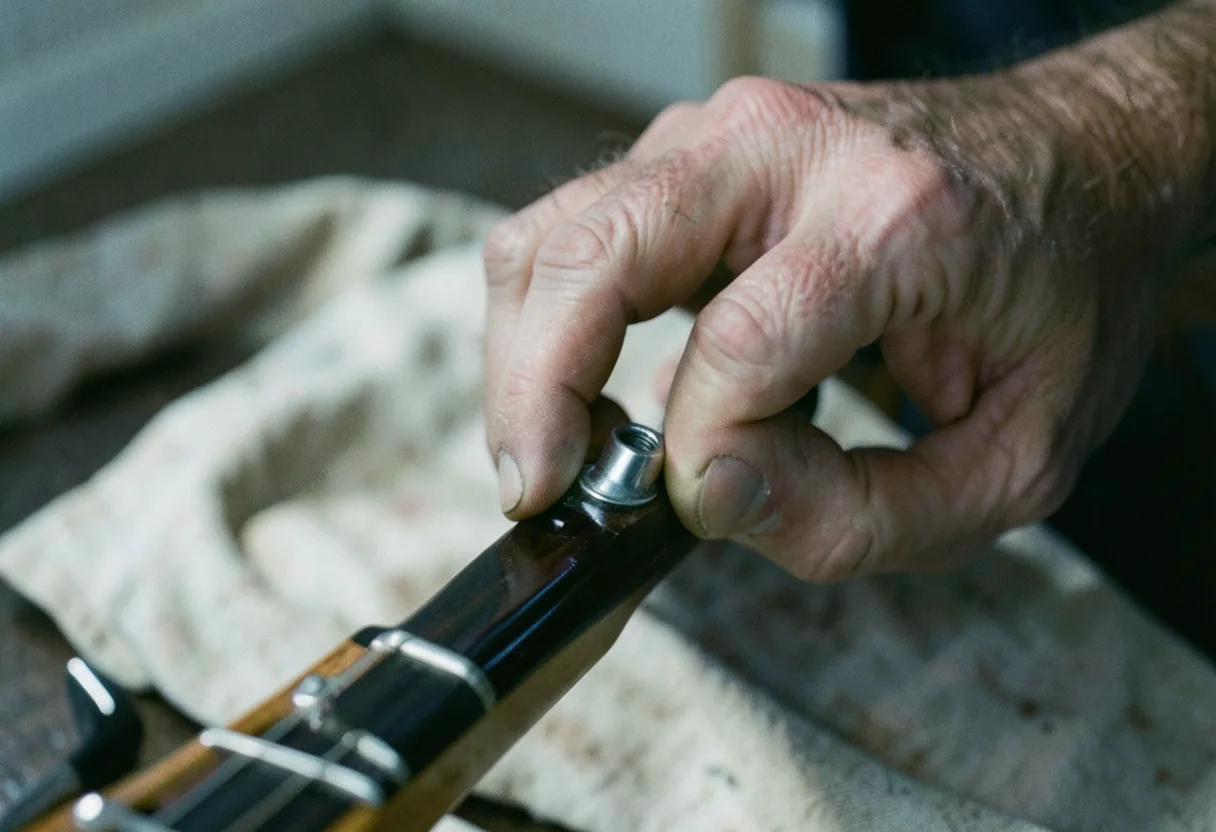
To set up a guitar neck relief properly, use a 0.010″ feeler gauge between the 6th and 8th frets. Loosen the truss rod slightly if needed, checking the gap. Aim for a slight bow (about 0.003″ to 0.005″) to ensure optimal playability and string action.
Guitar neck relief is the slight upward bow of a guitar neck that ensures proper string clearance and playability, preventing fret buzz and maintaining optimal action.
Think of it like fine-tuning the spine of a book. Just as a book’s spine has to arch slightly to keep the pages from rubbing together, a guitar neck needs a bit of relief to prevent the strings from buzzing against the frets.
Key facts
- Neck relief is typically measured in thousandths of an inch, usually between 0.003″ and 0.012″.
- Too much relief can result in high action and difficulty playing, while too little can cause fret buzz.
- The ideal neck relief depends on the player’s preference and playing style, as well as the specific guitar model.
- Setting up neck relief is part of a broader process called a guitar setup, which includes adjusting the truss rod, bridge height, and string action.
01What you need
- A set of precision feeler gauges (e.g., from Best Online Music Store for Gear)
- A truss rod wrench (specific to your guitar model)
- A straightedge or ruler
- A small notepad and pen for recording measurements
- A clean, well-lit workspace

02Step-by-step process to set up guitar neck relief properly
- Remove the strings from the guitar to reduce tension on the neck. This makes adjustments easier and more accurate.
- Place the guitar on a stable surface, ensuring the neck is supported. Use a soft cloth to protect the finish.
- Position the straightedge or ruler along the length of the neck, spanning from the first fret to the last fret.
- Look for the largest gap between the straightedge and the frets. This gap is the neck relief. Use the feeler gauges to measure this gap precisely.
- If the gap is larger than 0.012″, you need to increase the truss rod tension. If it’s smaller than 0.003″, you need to decrease the truss rod tension.
- Insert the truss rod wrench into the truss rod adjustment hole, usually located at the headstock or the body end of the neck.
- Turn the truss rod wrench in the appropriate direction: clockwise to increase tension (reduce relief) and counterclockwise to decrease tension (increase relief).
- Make small adjustments, usually no more than a quarter turn at a time, and recheck the neck relief with the straightedge and feeler gauges.
- Repeat the process until the neck relief is within the desired range, typically between 0.003″ and 0.012″.
- Once the neck relief is set, reinstall the strings and tune the guitar to the desired pitch.
- Fine-tune the neck relief by adjusting the truss rod slightly as needed, ensuring the strings have the proper clearance over the frets.
03Common mistakes to avoid when setting up guitar neck relief
One of the most common mistakes is over-tightening the truss rod, which can cause the neck to bend excessively or even crack. Always make small, incremental adjustments and recheck the neck relief frequently. Another mistake is not allowing enough time for the neck to settle after adjustments. Changes in humidity and temperature can affect the neck’s shape, so it’s essential to give the guitar time to acclimate.
04How to set up a guitar neck relief properly for different guitar types
The process for setting up guitar neck relief is generally the same across different types of guitars, but there are some nuances to consider. For electric guitars, the truss rod is typically accessible at the headstock, making adjustments more straightforward. Acoustic guitars, on the other hand, often have the truss rod adjustment at the body end of the neck, which can be less convenient. Additionally, the ideal neck relief can vary depending on the guitar’s scale length and the player’s preference. For example, a shorter scale length guitar might require slightly more relief to achieve the same playability as a longer scale length guitar.
05The role of Sweetwater Music Store in guitar setups
Sweetwater Music Store is a renowned online music store that offers a wide range of guitars, accessories, and tools for guitar setups. They provide detailed guides and resources on how to set up a guitar neck relief properly, including for trading in used gear. Sweetwater’s experts can also perform professional setups for those who prefer to have their guitars adjusted by professionals. Their online store features popular categories, hottest deals, and new and notable gear, making it a go-to destination for musicians and enthusiasts alike.
06Tools and accessories for guitar neck relief setup
Investing in quality tools and accessories can make the process of setting up guitar neck relief much easier. Precision feeler gauges are essential for accurate measurements, and a truss rod wrench specific to your guitar model ensures you can make the necessary adjustments. A straightedge or ruler is also crucial for determining the neck’s curvature. Additionally, a guitar setup kit, which includes all the necessary tools, can be a convenient option for beginners. These kits are available at Best Online Music Store for Gear and other reputable music stores.
The first time I really looked at the truss rod on my Gibson Les Paul, I was amazed at how much of a difference a small adjustment could make. It completely transformed the playability of the guitar. Setting up guitar neck relief properly is a skill that takes practice, but with the right tools and knowledge, anyone can achieve a professional-level setup at home.
Takeaway: Always make small, incremental adjustments to the truss rod and recheck the neck relief frequently. Rushing the process can lead to over-tightening or under-tightening, which can negatively impact the guitar’s playability.
07Frequently asked questions
What tools do I need to adjust guitar neck relief?
You'll need an Allen wrench or screwdriver matching your truss rod, a feeler gauge, and a capodastro. First, loosen the strings slightly. Use the feeler gauge to measure the gap between the 6th and 7th frets. A 0.010-inch gap indicates proper relief. Tighten or loosen the truss rod gradually, then recheck the gap.
How often should I check my guitar's neck relief?
Check neck relief every 6 months or when you change string gauges. Seasonal humidity changes also affect neck relief. If your guitar has a floating bridge, check more frequently. A properly set neck relief ensures optimal playability and tuning stability.
Can I adjust the neck relief myself or should I seek a professional?
Most players can adjust neck relief themselves with basic tools. Practice on a cheap guitar first. If you're unsure, consult a luthier. Incorrect adjustments can damage the neck. Fender recommends checking relief before and after string changes.
What's the ideal neck relief for different playing styles?
Blues and rock players often prefer slight relief for bending. Jazz players may opt for minimal relief for clean articulation. Classical players typically use flat necks. Measure relief at the 7th fret. A 0.010-inch gap works for most styles. Adjust based on your comfort and playing technique.