
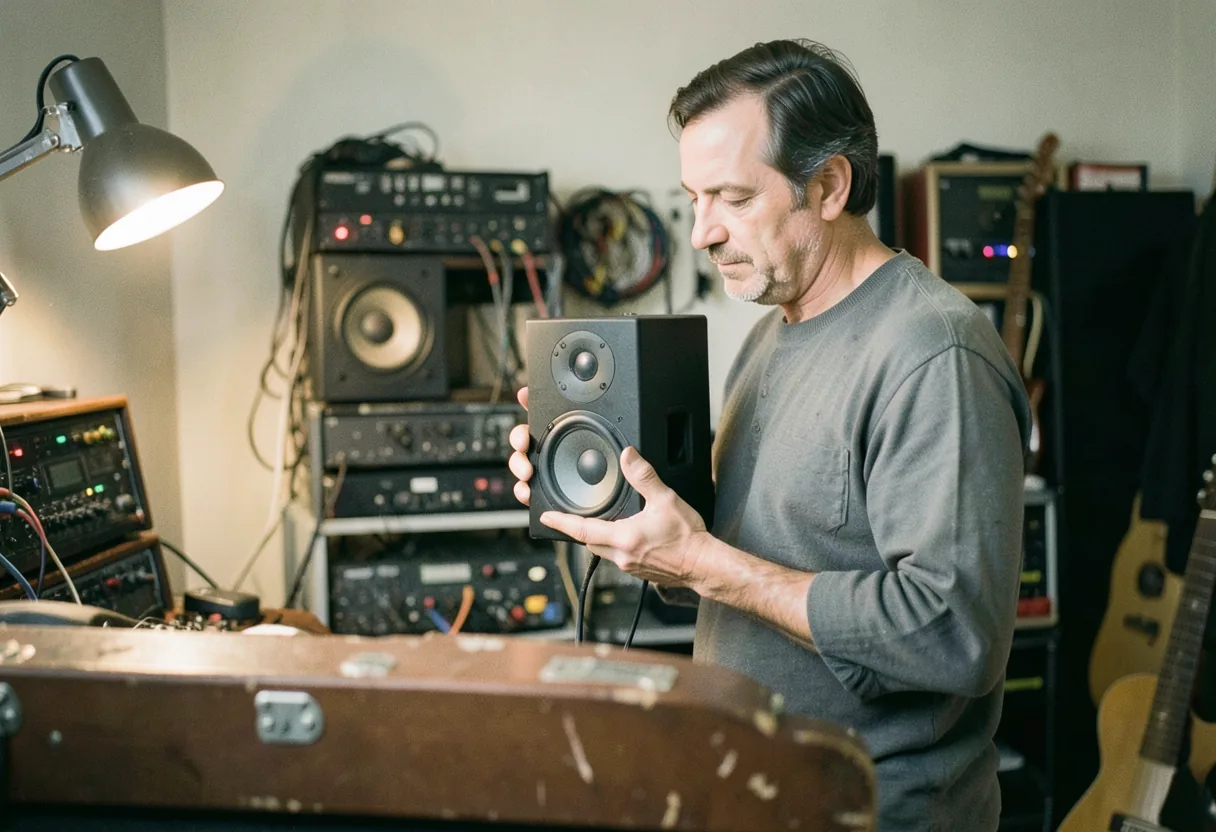
Choose studio monitors based on your room size and mixing needs. For small spaces, consider 5-inch drivers like Yamaha HS5; larger rooms benefit from 8-inch models. Ensure a flat frequency response for accurate mixing, and match speakers to your audio interface’s power output.
Choosing studio monitor speakers involves selecting nearfield speakers designed for accurate sound reproduction in a professional recording environment.
Think of studio monitors as the precision microscopes of audio equipment. Just as a microscope reveals the true details of a specimen, studio monitors reveal the true details of your mix, helping you make informed decisions about your music.
Key facts
- Studio monitors are designed to reproduce sound accurately, unlike consumer speakers that may enhance or alter sound for pleasure.
- Nearfield monitors are typically placed close to the engineer, minimizing room acoustics’ impact on the sound.
- Active monitors have built-in amplifiers, while passive monitors require external amplification.
- Studio monitors come in various sizes, with larger drivers generally offering better low-end response.
01What you need
- Your budget (from $100 to $10,000+)
- Room size and treatment (to minimize reflections)
- Monitor type (active or passive)
- Driver size (typically 5″ to 8″ for nearfield monitors)
- Frequency response (ideally as flat as possible)
02How to choose studio monitor speakers
- Assess your budget. Studio monitors range from affordable options like the Yamaha HS5 to high-end models such as the Neumann KH 310 A.
- Evaluate your room size and acoustics. Smaller rooms benefit from smaller monitors, while larger rooms can accommodate bigger monitors. Consider treating your room with bass traps and absorption panels to minimize reflections.
- Decide between active and passive monitors. Active monitors, like the KRK Rokit 8, have built-in amplifiers, while passive monitors require external amplification.
- Choose the driver size that suits your needs. Larger drivers provide better bass response, but may not be suitable for smaller rooms. Common nearfield monitor sizes include 5″, 6.5″, and 8″.
- Look for a flat frequency response. A flat response ensures accurate sound reproduction, allowing you to make better mixing decisions. Aim for monitors with a frequency response of 50Hz to 20kHz or higher.
- Consider the build quality and features. Look for monitors with robust construction, magnetic shielding, and useful features like room correction software (e.g., IK Multimedia’s ARCs).
- Audition the monitors in your room. If possible, listen to the monitors in your actual recording environment to ensure they work well with your room’s acoustics.
- Read reviews and comparisons. Websites like Sweetwater and Sound on Sound offer in-depth reviews and comparisons of various studio monitors.
- Check the warranty and return policy. Ensure the monitors come with a good warranty and a reasonable return policy in case they don’t meet your expectations.
03Common mistakes to avoid
One of the most common mistakes is choosing monitors based on brand reputation alone. While brand can indicate quality, it’s essential to consider the specific model’s features and how they fit your needs. Another mistake is neglecting room acoustics. Even the best monitors can sound poor in a poorly treated room. Always consider room treatment as part of your overall investment in studio monitors.
04Choosing between active and passive studio monitor speakers
Active studio monitors have built-in amplifiers, which simplifies setup and ensures optimal power matching between the amplifier and drivers. They are typically plug-and-play, making them an excellent choice for beginners or those seeking convenience. Passive studio monitors, on the other hand, require external amplification. This setup offers more flexibility in choosing amplifiers and can be preferred by experienced engineers who want to tailor their sound.
05Choosing the right driver size for your studio monitor speakers
The driver size of your studio monitors significantly impacts their sound and suitability for your room. Larger drivers can produce lower frequencies more accurately, but they may overwhelm smaller rooms. Smaller drivers are better suited for nearfield monitoring in compact spaces but may lack bass response.
06Top online music stores for studio monitor speakers
When shopping for studio monitor speakers, consider reputable online music stores that offer a wide selection, expert advice, and competitive pricing. Some top online music stores include Sweetwater, Guitar Center, and Musician’s Friend. These stores often provide detailed product descriptions, customer reviews, and helpful buying guides to assist you in making an informed decision.
07How to treat a small room for recording
Properly treating your recording room is crucial for accurate monitoring. Start by identifying the first reflection points from your listening position to the monitors and place absorption panels there. Additionally, use bass traps in the corners to control low-frequency buildup. Consider using a combination of absorption and diffusion to create a balanced acoustic environment. For more detailed guidance, check out our article on how to treat a small room for recording.
08Essential accessories for your studio monitor speakers
- Monitor stands or isolation pads to decouple the monitors from the desk or stands.
- Acoustic treatment panels to minimize reflections and improve sound clarity.
- Cables (XLR, TRS, or RCA) to connect the monitors to your audio interface or mixer.
- Room correction software to optimize the sound based on your room’s acoustics.
- Pop filters and reflection filters to improve vocal recordings when using the monitors for playback during recording sessions.
When choosing studio monitor speakers, prioritize accuracy and suitability for your room. Invest in quality monitors and proper room treatment to create a reliable mixing environment. Always audition the monitors in your space and consider your specific needs and budget. With the right studio monitors, you’ll be well on your way to producing professional-quality mixes.
09Frequently asked questions
What size studio monitors should I choose?
For small rooms, 5-inch monitors like the Yamaha HS5 are ideal. Larger rooms benefit from 8-inch models such as the KRK R842RK. Always match monitor size to room dimensions to avoid bass buildup.
Why do studio monitors need to be bi-amplified?
Bi-amplification ensures separate power for high and low frequencies, reducing distortion. For example, the Adam Audio T7V uses Class D amplification for each driver, providing precise control over the sound.
How important is the flat frequency response in studio monitors?
A flat response ensures accurate sound reproduction. The Genelec 8030C, for instance, has a frequency range of 50Hz-20kHz, helping producers hear mixes as they truly sound without coloration.
What’s the difference between nearfield and midfield monitors?
Nearfield monitors like the JBL 305P MkII are designed for close listening at 1-3 meters, minimizing room reflections. Midfield monitors such as the Focal Alpha 65 are used at 3-5 meters for a more immersive sound.